Friday, June 22, 2012

Times Past and Present


I got a phone call out of the blue from someone in Marion who is still connected to the Civic Theatre there, telling me he was again directing a Tennessee Williams play, “A Period of Adjustment” after 42 years passage of time.  I was in the original production, having one of the 3 leads.  George found my phone number after finding someone who knew my sister, Jane, and eventually I got a call from him, giving me the news above and inviting me to attend the current production. 

I was interested because I wanted to visit my sister and husband, who I hadn’t seen since our mother’s death, and to take a look at Marion and some of the places I used to live which totaled 6 different places.   In addition, of course, to bask in the past glory of my acting days and to visit with the other two leading actors in the original play. 

A group photo was taken of the past and present casts.


Marion Civic Theatre has a permanent home now, in the decaying town, built around the county court house, as so many Indiana towns first were established.  It is called the James Dean Theatre due to the fact that James Dean was born in Marion and is buried about 20 miles away.  Given the age of my readers here, it is with relief that I don’t have to educate anyone about who James Dean was.
I visited the first home I bought in Marion and I found it still looked really nice. When it was sold after my divorce, the front yard on 1/3 of an acre had no trees, a gravel drive way, and an unfinished patio.  I found so many trees on the lawn that the house was not visible to the road and I drove right past it.
To my dismay, the house the family lived in before we all left Marion is boarded up, as is the home next to it, both scheduled for removal.  The houses across the street are already gone.  I did note that the front door was still painted a bright red (my doing).  My sister says the neighborhood became unsafe and no one wanted to live there anymore.
I visited my deceased wife’s grave and took a few moments to reflect on my life with her and the mostly good times we shared together.  I loved her very much and her loss was devastating.  However, her death was the impetus for me to leave Marion which benefitted everyone in the family.  I still ponder the irony of this. 
Gone are the two best restaurants in town, Irma’s and Emily’s and the best fare is now found at Appleby’s where flat screen TV’s adorn the wall providing distracting noise and unless you find a booth, you sit on stools.  Jane and Bill travel to Fort Wayne to eat out a distance of 50 plus miles.  This fact reminded me of how I used to travel to Fort Wayne, Muncie, Kokomo, Huntington, Indianapolis without giving it much thought, putting about 15,000 miles a year on my car. 
How fortunate I am to live just off the edge of Chicago, two blocks from a lake beach, where I can take the el to Wrigley Field or Sox’s Park dine at the finest restaurants, etc. etc.
Judith and I leave in 6 days to attend Kristi and David’s wedding on top of a mountain vista near Boulder, CO.  As some of you may know, his name is David HeArd, and Kristi gave him the nickname of SV, which stands for superfluous vowel.  It is unknown at this time whether she will take the SV or not for her married name. 

The entire family will be there and it is with great anticipation that I look forward to this joyous event.

Sunday, May 20, 2012

My home town-Council Bluffs


Today the Chicago Tribune had a feature story in their Sunday issue travel section about the Iowa rail museum in Council Bluffs.  This brought back many memories about CB, Abraham Lincoln, and my interaction with railroads.
I will begin by stating that I have always been slightly embarrassed to tell others I don’t know well, that I grew up in Council Bluffs, because the mere sound of saying it would create an image in their mind that would rub off into something negative towards me.  But in my heart I hold my upbringing there to be very dear.  Just give me an opportunity to explain why growing up is something to be proud of.
If I had my way, every child in America would know that the Abraham Lincoln’s dream of a trans-continental railroad line started at Council Bluffs, Iowa. And tourist travelling through or in the larger city across the Missouri River named after the Omaha Indians, would flock to the Iowa rail museum and the Golden Spike monument that honors the completion of the Union Pacific railroad. 
Lincoln came to Council Bluffs in 1859 to deliver a speech on his abolitionist views and met General Greenville Dodge who advocated for railroads to move westward.  Lincoln apparently was pre-disposed to this idea because it had been talked about since the 1830’s. Plans were drawn up and Lincoln approved the route Dodge suggested and Dodge became the chief construction engineer. Using scores of Irish immigrates and discharged Civil War soldiers; the track was slowly laid across the plains and through the Rockies.  At the other end of the continent, the segment started at Oakland, CA met with the western bound segment at Promontory Summit north of Salt Lake City, May 10, 1869 where a golden spike was used to complete the final stroked stake.
The trip across the country changed from 6-8 months by ship around South America, to 7 days.


This is the General Dodge home, now a museum.  I went through the house with my aunt and mother just before just before it was open as a museum, lo these many years ago.
Council Bluffs became a railroad town and once was a meeting place for nine different railroads and in the 1930’s it was the third largest railroad center in the nation.  My friend’s fathers and brothers worked in some way for one of these railroads with the Union Pacific still being the major player.  I worked at the Union Pacific ice docks two summers during high school and college, icing refrigerated fruit and vegetable laded railroad cars.  When I left college for a year, I worked at UP headquarters in Omaha, while I trained at night to become an Arthur Murray dance instructor.  I was able to buy my first car, a 1950 Mercury, from my UP paychecks.
I went to Abraham Lincoln high school and there is a Lincoln Memorial on a bluff where local lore has it that Lincoln looked out from this vista across the Missouri and uttered his vision of seeing a railroad scan the continent.  I suspect that the memorial is just to honor that fact that Lincoln chose Council Bluffs as the origin, knowing that local lore gets stretched a bit in favor of a more romantic version.
Here you see Omaha in the distance.
Growing up in Council Bluffs provided both a small town atmosphere with easy access to Omaha. I rode many a street car and later a bus between the two cities. 
I always look forward to attending my class reunions and driving by the two homes I lived in there.  It seems to emphasize the journey I have traveled since I left there. 


Saturday, March 17, 2012

Venice


We left early morning from Madonna di Campaglio on a smaller bus from Venice making many of us crowded and wanting more leg room.  Not everyone on the ski trip journeyed on to Venice accounting for the size reduction of the bus.  The 3 hour trip was extended by a rest stop as there was no bathroom on board, plus time for the driver to stop at his depot to ask direction, and we finally arrived at our hotel where we were acquired to check in individually. As you might image, when with a group, one does not stay at one of the more expensive hotels.  However, the Bologna Best Western is a fine hotel it just is a long way from the center of Venice or access to the canal buses. 
I roomed again with Vladimir, who turned out to be an excellent roommate and companion as we managed to see most of the main tourist sites in Venice. Our room as not ready when we arrived to the hotel gave us complementary coffee and snack while we waited a short time.
Finally we were ready to leave for San Marco Piazza at 4:30 and having secured bus and water bus tickets for 48 hours from the hotel, we were off.  The bus stop was right around the corner and after a 15-20 minute bus ride we arrive at the Grand Canals, found the correct water bus.
Keep in mind that it is winter and Venice is in Northern Italy, so it is cold out and most people huddle inside.  My priority however, it to take photos, so I am at the bow of the boat with my camera out ready to take a photo of anything interesting as long as I can compose the  delete it right then. So here goes.
The last photo is of the Rialto Bridge and all were taken from the Grand Canal.
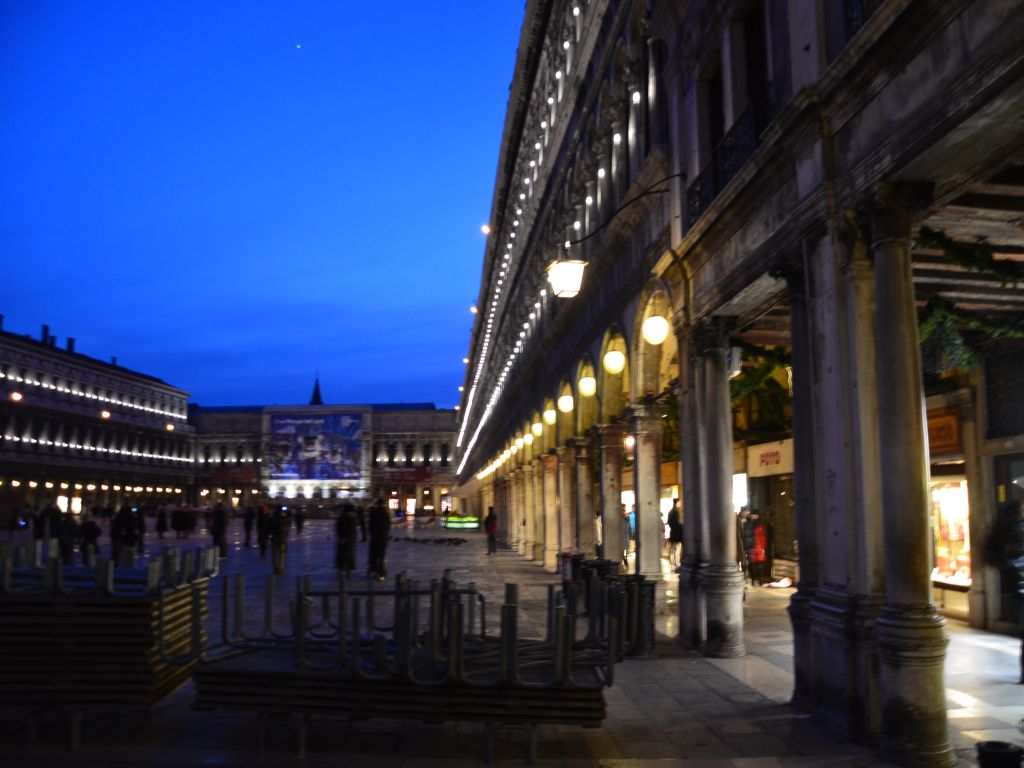
As the light fades, some good shots are still available.
And here is San Marco Piazza and one of the adjacent shopping streets.

We get an early start the next morning and find out there is an express water bus to San Marco.  We hit the Doge’s Palace first.  Venice was once a city state and the head man was the Doge.

There is a prison in the building and the bridge across to the prison is called the bridge of sighs.  Here is Vladimir with the bridge in the background.  By the way Vladimir is a happy guy most of the time but I think they teach them in Russia to pose with a sober face.

We go St. Mark’s Basilica and go inside.

We take the elevator up the campanile bell tower and capture some great vistas.
We travel to another island to see the Murano Glass Works home of Venetian glass where we witness one of the glass masters at work, from start to finish.
I mention that I had been through Corning Glass Works so one of the owners took us upstairs to see many great glass art and I was indeed tempted to buy something but I declined.  I did buy a small crystal vase at another shop as it was easy to pack into my suitcase.
These were all made out of glass.

Some other photos
And I shot this model doing a pose for her camera.

The last day we took a walking tour and learned much about how the city was founded, how it was built, how the sanitary system works, how the city is sinking unevenly, and that the city is so crowded in the summer that you can barely walk through some of the narrow walkways.
Pisa is not the only place where there is a leaning tower.
We made it back to our hotel just as our bus tickets were running out.  We left very early next morning and the hotel supplied us with a breakfast bag.  I had a great time in Italy.

Sunday, March 11, 2012

Skiing the Italian Dolomites


About 32 Chicago area skiers, traveled to Madonna di Campiglio, in northern Italy, near the Austrian boarder, by way of Verona and a 2 ½ hour bus ride from there.

Being Italy is extremely Catholic, the name of the town did not come as a complete mystery and sure enough, the first buildings there included a church and part of the church is still standing. 


After checking into the Hotel Rafael, many of us traipsed off to rent some skies at this obscure shop following a rough map of the town and after walking through most of the town, we managed to find the sign.  We took the small elevator down one flight wandered into this small shop, the size of a studio apartment, filled with skis of several makes and sizes.  The owner and one assistant waded through about 15 of us, adjusting our bindings, sticking labels with our names on the skies, which then thankfully were delivered to the ski room of our hotel which freed us of the necessity of toting them through the town and up the hill.


Great, I thought, all set to ski in the morning.  In Europe, the dining room opens about 7:30 so we didn’t missed dinner after traveling overnight to Frankfort, having a significant layover for our flight to Verona, and the aforementioned bus ride, we all thankfully filled our appetites and turned in early.


The trip was organized by CMSC (Chicago Metropolitan Ski Council).  My club, Lake Shore Ski Club, is a member of CMSC as are all the other ski clubs in the surrounding area so the trip was filled with members of various ski clubs.  However, there were other members of Lake Shore on the trip and we formed a natural clique who skied and ate together.  Claude and Yann, two Frenchmen and Vladimir, a Russian and I skied together until the last day.  Both Claude and Yann are chefs and it is routine for them to make connections with chefs wherever they eat.  So soon were receiving a modicum of special attention mostly by receiving recommendations on the nightly menu.

The food was the best ever for me for a ski trip.  Nightly dinner began with a salad bar, appetizers followed, pasta next, then the main course, topped off by dessert all of which were better than average.  And throughout the week, the menu changed giving us plenty of variety to choose from. This is a lot of food, but we were burning enough calories by skiing that we devoured everything, every night. 

Instead of requiring passport size photos for a laminated ski pass, my photo was taken at the ticket window and my image was put on a credit card size ski pass which used Radio Frequency ID technology to permit entry through the gondolas turnstiles.  This system is far superior to having a paper pass with a bar code which requires scanning by an operator from the viewpoint of the skier in that RFID can be scanned through clothing.  So if you are bundled up, there is no need to unzip your jacket and dig out your pass.   

Like many European ski areas, there were a number of interconnecting slopes which all provide a route down to a village or town and a gondola back up.   
Madonna di Campiglio, in the Trentino-Alto Adige region of Italy, is a large resort with 19 lifts (5 gondolas, 12 chair lifts, 2 surface lifts) that offers skiers an incredible 1000 meters (3281 feet) of vertical descent. It has 35 pistes with a total length of 60 kilometers (38 miles). The majority of the pistes at Madonna di Campiglio are covered by snowmaking.

And there are many spots at higher elevation to stop for a drink or food at family owned establishments.  In fact this is one of the more pleasant aspects for skiing in Europe.  It’s almost like eating in someone’s home.  Locals always seem to know where the best places are and it is best to come in early for lunch or after 1 PM to avoid the crowds. We did a very good job of skiing the entire area. 

Here are my three skiing companions, Claude, Yann, and Valdimir.
And one of me with a great background.
The ski trip included a 2 ½ day trip to Venice which my roommate Vladimir and I went on which the two Frenchmen departed for the states.  We hope to ski together in the future.


Friday, December 23, 2011

Going Downhill Fast


“Dave Herd, we need someone to go over and race with the class “D” group.”

I had started skiing about 3 years before, taking my first ski lesson at Greek Peak, a small ski area near Cortland, New York, half way between Binghamton and Schenectady.  My girl friend’s home town was Cortland and she was a part owner of a condo just across from the ski area on the town’s outskirts.  At that time, Patricia and I were involved in a new and exciting romance.  We met because I was friends with her ex-husband and when I moved the family to Lancaster, PA, she was there, she was strikingly beautiful, and we were both single.  We had much in common and loved active sports.  What was not to like?

During Thanksgiving weekend 1979, we drove up to Greek Peak with my daughter and her two sons, to spend a couple of days on the slopes.  Talk was that my daughter, Kristi and I would rent ski equipment and take beginner lessons together, while Patricia went skiing with her sons.  And so it happened.

I was both anxious and exhilarated to begin skiing.  I had never been remotely close to skiing and never even knew anyone that was a skier until I met Patricia, other than her ex-husband.  Burnt in my memory forever, is how awkward I felt when boards were put on my feet and I was asked to then walk sideways up a very slight knoll to begin my first descent.

Kristi and I were athletic and determined to become comfortable with the label of “skier” and after many failed attempts to remain upright we were soon making turns with our skies formed in the shape of a wedge.  As I progressed in honing my incipient skills I realized that skiing is all about overcoming fear by gaining both skill and confidence motivated by desire to succeed. Soon I was able to advance to the chair lift and the bunny hill. 

A year later I was able almost keep up with Patti.  She was an elegant and graceful skier while I relied on brute strength and courage trying to master both speed and control.  Many times losing control resulted in spectacular wipe outs resulting ski, poles, hats, gloves, and goggles flying off in various directions with me bravely struggling off still another bruise.  One morning while on a week long ski trip, I was so sore and beat up that I had difficulty getting out of bed after one day of skiing.  I decided then and there that I would devote my efforts to mastering more control and sacrifice some speed, and then start to bring back the speed once the control was better established.
Eventually my days living in the East came to an end and a couple of years later, our romance finally ended also, but the skiing stayed with me and remains to this day.

 Dave Herd, we need someone to go over and race with the class “D” group.”  It is March 1983 and I am on a Midwest bus weekend ski trip with Fort Wayne Ski Club. The person talking to me is the race captain for the club.  We are at Boyne Mountain, near Petoskey, Michigan and all ski clubs that belong to the Indiana Ski Council have descended there for a weekend of ski racing, drinking, and making out as much as possible. 

I explain to the race captain that I have never raced before but that does not dissuade her from enlisting me.  I am given instructions where to go and soon I am standing in line with a numbered paper racing bib on my chest waiting to go as fast as possible around poles with flags on the top and to do so without falling down.

By this time, I have had time to size up some my competition and it is pretty plain to me that I can ski as well or better than most of them as determined how they looked skiing over to the starting area.  Thankfully, I was not one of the first to plunge down the slope so I have a chance to observe what some of the better skiers did.

It seems that there was this wand across the starting place and as soon as your legs push through it, the timer clock starts running and there is an electric eye at the finish line, which stops the clock when you break the beam.  So from my observation point, the goal was to get going as fast as possible at the start.

When my turn comes, I place my poles over the starting wand and as I wait briefly to hear that the course is clear, I try to think, “breathe out fear, breathe in energy” in an effort to eliminate my considerable anxiety.  Suddenly I hear, “go when ready racer” from the starter.  I push out with all my strength and skate hard towards the first pole. Around the first 3 flagged poles (I learn later to talk them “gates”) I go, trying to look ahead and see the next challenge.  I am picking up speed as the slope gets steeper.  At the fourth gate, my instinct takes over and my weight goes to the tails of my skies causing to spin 180 degrees and almost fall down.  I turned about as fast as possible and continued until the 8th gate where a reoccurrence took place.  I recovered again and continued on through the finish line, disappointed that I didn’t do better, but I heart was pounding and I felt the adrenalin kick in.  “Wow, I want to do that again, I know I can do better”, were my thoughts.

And so it began.  Later that night at the awards banquet, medals were handled out for the first 10 places in each racing category.  I came in 9th even with all the mistakes I made and I was amazed.  Obtaining a 9th place medal in the lowest race class helped me realize I had potential but that is something I kept to myself because a 9th place finish is not exactly something to bring up at a cocktail party.  But the fire was inside me and it burned intensely. 

Two years later I won the ski club’s “Most Improved Skier” award and also the Veteran Men’s Challenge Cup for my overall season performance covering several races.  My name was engraved on the club’s huge Challenge Cup and I was presented a miniature cup to keep.  I got to keep the big cup for a year and fortunately I had a fireplace mantel to give it prominence.

When I came to Chicago and joined Lake Shore Ski Club, I was soon well known because I started winning the club’s ski races dethroning the long time champions.  This in turn led to becoming the club’s president as well as several other positions within the club. I became a certified ski instructor when I retired and I also met my wife on a weekend bus trip.

I have a trophy case filled with medals and trophies and sitting in the center is my 9th place medal in honor of how it all started.  I sometimes think of Ted Baxter on the Mary Tyler Moore show who liked to say, “It all started at a 5000 watt radio station in Fresno, California”.  My saying would be, “it all started at a “D” level race course in Boyne Mountain Michigan.”

Skiing is a life sport and if there is a desire to keep improving, it is possible.  This requires more mental than physical effort.  So as I start my 31st year skiing, I am positive that I will continue to improve, not only as an all around skier but on the race course also.  It probably it unrealistic to think this will continue forever, but I really don’t want to think about it.  Not now anyway, I am having way too much fun.

Saturday, November 26, 2011

My Acting Career


While attending Iowa State, I was in the cast of the university’s annual open house show called “Stars Over Veishea” twice participating as a dancer.  Veishea is an acronym formed from by using the first letters of the five colleges at that time, Veterinary medicine, Engineering, Industrial Science, Home Economics, and Agriculture.  I was and still is, the largest student run university musical events in America.  In addition, I performed in the annual Modern Dance Club recital each year I attended ISU.  These activities helped me immensely by providing me diversions from my rigorous engineering studies and various jobs I needed to have to provide money for myself. 
Anyway, I had dancing in my blood and spending a year out of college dancing and teaching at Arthur Murray’s only reinforced my craving.  So I after the family and I moved to Dayton, Ohio to work at Frigidaire and after I got settled, I started looking for a way to continue dancing on stage.  I got a part in “Guys and Dolls” being produced by Dayton Community Theatre.  I didn’t have a speaking role but I was required to look slightly thuggish, something I probably have a natural talent at. 
One day, the actor (who resembled Pacino) got a hair up some opening of his body which seems to irritate him to no end and I noticed it caused the director to question his whole approach to playing the part of Nathan Detroit.  He and she had words, He walked out. The director turned to me and said, “I want you to play Nathan”.  I was stunned and did not feel I was ready to make such a psychological leap, and I protested, sighting my lack of singing talent, only to be cajoled and “a we need you now” plea from the director. 
So for two nights, I held my play book and read my lines to help out, and felt the first realization that I was starting to enjoy this and all the challenges it might bring.  Then HE came back.  The humble and contrite one came back and reclaimed his rightful place as Nathan Detroit, leaving me with mixed feelings, with relief being the strongest one.
So the play went on and was performed and we all did a great job.  I studied how to play the part of Nathan secretly, just in case.  Nathan was the central figure in the play and the actor did a great job.  It was a great feeling to be in a cast, to be part of something that was so rewarding. 
My wife and I did meet a lot of people in amateur theatre after that and much of our social life was tied to people that attended amateur theatre or took part in it. 
Eventually, we moved from Dayton to Marion, Indiana home to RCA and a manufacturing plant just starting to mass produce color picture tubes, where I work at various engineering related jobs. 
After one lives in Marion for a while, a town of 42,000, one finds time to wonder “that am I going to do with all this time on my hands?”  I searched and found Marion Civic theatre in answer to a small notice in local paper of tryouts for the play, “Never Too Late”.   I went only to check everything out but was asked to read for a very small part in the very first of the play.  And I walked away with the part of Doctor Kimbrough. 
As it turned out, this was my first role with many others to follow.  I can count 26 roles I had either at Marion Civic Theatre or in Kokomo Civic Theatre.  Probably the roles I had most fun portraying was Oscar, in “The Odd Couple” and Col. Thomas McKean in “1776”.  What roles do I think I portrayed the best?  That would be the brother Tom in “Glass Menagerie” and Creon in “Antigone”. 

And I directed 8 productions including, “Music Man”, “Picnic”, “Antigone”, “I Never Sang for my Father”, “Plaza Suite”, “Six Rms Riv Vu”, “Prisoner of Second Avenue”, and “Play It Again Sam” with the help of my daughter Vikki. 

The photo below was taken for the Kokomo Civic Theatre program of "Desperate Hours" where I played an escaped convict, one of Humphrey Bogart's roles.

I was president of Marion Civic Theatre for a long time, I build sets, I lugged chairs and platforms, I helped with lighting, and I sold tickets along with several other dedicated people.  It was what I did, that, and playing golf in the summer.
Vikki went off and became a theatre major, first at Penn State University, then at Pittsburgh University where she received her MFA.  She has used her talent by appearing in several plays in small Chicago theatres, before getting married to an actor and moving to Los Angles.
When I moved away from Marion, I never felt the urge to start over at another amateur theatre group.  I found skiing and tennis and they have commanded my attention.  I did gain a lot in my theatre experiences and I did slowly become a better actor and perhaps if I stayed with it longer, I could have become a good actor.  But the flame that burned so intensely for such a long time is keeping me warm and comfortable now by my occasional looking back at it with wonder. Ok, with a little pride also.

Wednesday, November 2, 2011

My Music Career


Looking back on how I started to try to master the piano, I can point all fingers at my mother.  I never quizzed her later in life or at the time how she came to be a somewhat competent pianist, but she could play pretty well and had memorized permanently a couple of rather sophisticated pieces. 
The first house I remember living in was at 122 Grace Street in Council Bluffs, Iowa.  I don’t remember that there was a piano in the house.  We moved when I was in first grade to 620 Harrison Street so I must have been between 5-6 years old and my mother had acquired a Steinway upright that must have been handled down from her family. How else would she be able to play?
Pianos were much more popular in the 30’s and 40’s in households back then and having one was a symbol of status and, in the days before  television, were a source of entertainment.  If there was a piano in the house there was someone who could play it, and people could gather around and sing carols at Christmas time or when company came and the conversation started to drag a bit, the piano was used to put some energy back into the room.
My mother arranged for me to start taking lessons soon after we moved.  And like all beginning piano players back then, I was taught out of Thompson music books.  I can remember that first I was taught to read notes in the treble clef and used my more dexterous right hand, then the bass clef using my left hand.  I was quite proud when I played my first tune using both hands at the same time.  Soon I was able to translate what I saw on paper to my fingers which produced correct sounds that reinforced what I was doing.  If the product didn’t sound right, I knew I made a mistake.  What took place also was the ability to later be very accomplished with the typewriter.  At the time I took typewriting, I was the second fastest typist in my class and the fastest was a girl who was a better pianist that I was and never got anything but “A’s” for grades.  I am sure this speaks to my brain getting itself organized to be adept at hand-eye coordination. 
As I advanced through the Thompson books I soon reached a point where sheet music was introduced.  Each year as I advanced through grade school, my musical talents also improved.  At some point I studied under Mr. Sandborn whose studio was in Omaha, just a short distance from where my father worked.  To attend my lessons, I would leave after school traveling by way of a neighborhood streetcar to the center of Council Bluffs then transferring to the Omaha streetcar.  Later the streetcars were replaced by buses, but the routine remained the same.  After my lesson, I would eat at the diner my father managed before making the return trip.  Four times a year, Mr. Sandborn would hold a concert in his studio with a program supplied listing all his students in order of skill, with the most skilled playing last.  As I grew older and more accomplished, I managed to play third from the last before moving on to a different teacher. 
My move was done to avoid the long trek to Omaha and to study under a woman who would teach me ragtime and boogie and other music of my own choosing.  I played with a lot of passion but my fingering technique was anything but classical.  This finally caught up with me when I tried to play more difficult pieces, like a Rachmaninov where all five digits of both hands need to strike the keys rapidly to produce dramatic wonderful chords.
Harrison Street grade school only went up to 5th grade.  So for 6th grade I transferred to Washington Street grade school which went up to 8th grade.  This was the first time I didn’t stay in one room for the entire school day.  There were 6 rooms for 6th, 7th, and 8th grades, two for each class, and we rotated after each hour.  Classes were English, arithmetic/spelling, art/reading, geography, physical education/science, and music/penmanship.
Our teacher for penmanship and music was Miss Wind.  I imagine she was in her sixties because she had white hair.  She was tall and always dressed in long black dresses with accompanying old lady black shoes. And she was not especially fond of children, particularly those of the male gender.  It all honestly, her appearance could have made her eligible to be a character in the TV show, “The Adams Family”.  However, the characters in the show seemed to be happy with their macabre outlook, and any display of being happy was not something she shared with her classes.
I am not sure how this started but, sometimes she would leave the room and my classmates egged me on to play the piano while she was absent.  So I played “Bumble Boogie” or “Sabre Dance” which I had memorized, to the delight of my classmates, whose ears were longing for something other than Brahms, Bach, or Beethoven.  Of course, she happened to come back as I was playing, but I think she was in a position where she could not disapprove.  After all, it was a music class.

In my class reunions many years later, my former classmates would reminisce with me about my boogie-woogie days, something I had forgotten about.  I guess I made a lasting impression in a very small way.
When I was in high school, the music teacher encouraged me to play the organ situated in the school auditorium during my study hours and I continued to dabble here and there playing for school events.  But I had long stopped taking lessons and my interests in sports, girls, and making money dominated my life to the detriment of my music career. 
I have no regrets about this.  I make no efforts to dig out my electronic keyboard, the sheet music I still have, and play to amuse myself.  But, if I had a baby grand sitting in my front room, I would be tempted to give up crossword puzzles and to master those wonderful Rachmaninov chords.

Saturday, October 22, 2011

The Trek to Mount Bromo


Due to some mix up, the driver was not here to pick us up at the Surabaya airport and we had prepaid.  When something like this happens in a foreign country where not everyone speaks good English, it can be the cause of some anxiety.  But Judith was on phone soon, after a few challenges, and was told that the driver was waiting at the train station and it would take 30-45 minutes to get to the airport.  He did come thankfully.  This resulted in a 90 minute delay in getting started on our 3 + hour road trip through insane traffic. But once we started up the mountain we saw an entirely different view of Indonesia. It all started when turned off the main road and started up the mountain.  Soon the vegetation started to change and the road turned from a smooth wide 2 lane avenue with few mild curves to a rough, narrower road with hairpins turns the norm. 
We arrived at the Java Banana hotel, high up the mountain, and the receptionist had no idea of our problem.  We were angry that we missed seeing the sunset due to our delay plus all the hassle we had to do through. We had difficulty negotiating some compensation at first, but in the end things were made right. The room had a great view and was well appointed. There is no internet and no TV except fuzzy local channels, but we didn't care as our main priority was to get up at 3 AM and travel up the mountain via jeep, horse, and foot to reach a high spot for viewing the break of day and to see the shadows and colors around Mt. Bromo, an active volcano.
We had the sequence of events explained to us when we checked in, so as scheduled we were ready to hop into a jeep at 3:30 AM and after 20 minutes up a twisty, dusty, bumpy road upward, the caravan of jeeps peeled off and parked.  I unfold my legs and climbed out.  Up the trail we started and after rounding a curve, came upon the horses and horse valets (to make up a concept) who wanted money to rent their wiry, small horses to take us up the mountain.  It did not take long for us to agree that horsepower was the way to go.  And best of all, the men walked with the horse leading him by the reins.  All we had to do is hang on for dear life.  This is not an exaggeration.    
But eventually the trail narrows again requiring the last leg to manpower.  Fortunately, there are well defined steps and we reach the top, stopping along the way to let our lungs take in as much oxygen as the thin air will allow.  The flat area at the viewing point looks like a miniature village with the local Tenggerese people there with small fires ablaze to heat water for instant coffee, tea, or hot chocolate to sell to the tourist and well as knit hats and handicrafts.
We arrive about 5 minutes before the sky starts to light up.  Capturing the sequence of the sun rise is on everyone’s agenda as people jostle amongst each other to position their cameras with clear shots of the event.


Soon there is enough light to see the three volcanoes, two which line up as if drawn from the same axis.

In the foreground is extinct Mt. Batok with Mt. Semeru behind it.  Mt. Bromo is just to the left of Mt. Batok.  The top of the volcano has been blown off.  It last erupted in January 2011.  Mt. Semeru is one of the most active volcanoes in Indonesia, spewing off ash and smoke about every 20 minutes.
After more light I can see how far down the jeeps are parked.
In our descent, clutching onto the horse’s saddle becomes even more challenging because we need to lean back slightly due to the steepness of the slope.  Back in our jeeps, we travel to another vista where we can see the other jeeps trekking across the “Sea of Sand” to the Hindu temple at the foot of Mt. Bromo.  Look closely to find it.
We declined this part of the tour due to the requirement to do more climbing in the volcanic dust up a very narrow trail without the aid of horsepower.

 Legend of Mount Bromo

There is legend related to Mount Bromo and the region of Tengger. According to this legend, there was a 15th century princess named Roro Anteng from Majapahit who started a principality with her husband Joko Seger. They named the principality Tengger, an amalgam of the last syllable of both their names.

Being childless for many years, the royal couple made a trip up Mount Bromo to seek the help of the mountain gods in granting them a child. The gods agreed to their request, telling them that they would have 25 children, but demanded that they sacrifice their final child. Together, the couple had 24 children.
When the last and final child was born, Roro Anteng refused to sacrifice it. The mountain gods sent fire and brimstone until she finally relented. After the child was thrown into the crater of the volcano, anhis voice was heard asking that an annual ceremony be performed to appease the gods. The ceremony was still being performed to this day. It takes place on the 14th day of the full moon Kesodo, according to the Tenggerese calendar. Rice, fruits, vegetables, flowers and livestock are offered to the mountain gods.
Dear readers, it strikes me that if you happened to be born into a Tenggerese family, you would probably be trekking up to the rim of the cauldron each year, chicken and rice in hand feed the god anhis.  What you wouldn’t be doing is observing special dietary rules, travelling to Mecca, confessing your sins, setting up nativity scenes at winter solstice, going through prostrating rituals, lighting a lot of incense, wearing funny hats, or privately donning special underwear.  You probably would hope that your capricious god would be satisfied enough protect you from the dangers of the world and offer your inner spirit a safe haven after your earthy remains are scattered to the winds.  The more pious amongst your people would know that your god has favored your tribe with the unquestionable truth on how to achieve everlasting peace and any other visions need to be rejected by whatever means necessary to keep your mind cleansed of disturbing evidence to the contrary.

Our jeep driver must have been blessed with skill, acquired knowledge, and confidence because we arrived back at the Java Banana safely.  We took time to meander through the unique flora and feel the warm sun increase the temperature to a pleasant level as we wait for breakfast.
This photo was shot from the grounds showing the small but beautiful Tenggerese houses and an onion field which, along with potatoes and cabbage thrive in the rich soil and cool temperatures.  The houses are constructed mostly with tile and cement which probably is a result of learning to keep trees to help prevent soil erosion.
We leave late morning for our trip to Surabaya and have a chance to see the terrain, villages, and people as we wind our way downward.  Our delayed trip up the mountain was done with darkness close at hand.
We get to the main road to Surabaya and our young driver maneuvers in and out of out-of-this-world traffic insanity of motorcycles, aggressive tour buses, slow over-loaded trucks, ox-carts, bicycles, and risk taking cars and after over 3 hours we get to our hotel in Surabaya, the Hotel Majapahit Surabaya.
Hotel was built around 1910 and is in great shape with 143 rooms and the largest Presidential Suite in Asia. It has a very rich history. I wrote a review on Trip Advisor entitled, “Grand, Old, Elegant Hotel, and great value”. In the restrooms outside of the rooms in other parts of the hotel, it has pull chains for the toilets and long urinals in the men's rooms. Floor standing mirrors, old heavy wooden furniture in great shape, old chandeliers and ceiling fans.  The hotel sits on a very busy street but the property extends far away from the street and no traffic could be heard. 

Judith had business the next day and I hung out at the pool and spa relaxing before travelling back to Jakarta the next day.  There are so many wonderful places to visit in Indonesia and Mt. Bromo and Surabaya should be on any tourist’s short list.