Tuesday, April 7, 2009

Memories of WWII

It has been my desire to write about my experiences I had as I grew up so my children and their children could have a little insight into their heritage. My grandmother wrote about her life growing up in the middle of Nebraska and I read things she wrote with great interest.

I found out there is a local college that offers adult education classes so I signed up for a writing class. I didn’t know exactly what to expect, but I soon found out that the class time consists of each class member reading aloud what they have prepared each week. There is no restriction about subject matter. There is no critique of the writing, nor are there suggestions given on how to improve. So I guess the main purpose of the class is to write.

So I am posting my first effort and will continue to do so as the class moves along. I have added picture in this post of the sake of providing further impact to support things as I remember them.

Memories of WWII

I remember the day Pearl Harbor was bombed, Dec. 7th 1941. I had just turned 6 years old. The reason I remember the day was because my parents were huddled around the radio listening with obvious angst. Children are very sensitive to the fact that their parents are in stress as their well being is at stake. Had I not walked in and witnessed them, I would not have remembered this day. It was their tension that I remembered more than anything.

I asked what the matter was and at first they were at a loss for words to explain something like this to a six year old, but they told me something that did not cause me worry, but did solicit further questions.

The next time I was really aware of the war was in 1943 when I was in 3rd grade. Our school held regularly scheduled paper, rubber, and scrap metal drives. Our school went up to 5th grade, and all students from 3rd through 5th grades were let out of school for a morning to scour our neighborhoods from door-to-door collecting what households had set aside for us.

Toothpaste tubes were metal in those days as were the caps. Every household saved these for our collection although the volume of metal was slight. When a tin can was emptied, both ends were pealed off, stuck inside the can cylinder and then stepped on to flatten everything. Then the paper was stripped off

If you had a wagon you brought it to school, to be used it to collect stuff. When it was full you pulled it to the school yard, emptied it, and hurried off for more precious cargo.

Another war effort could be found in school. Every Friday, students would bring a dime or quarter if they had one and buy a U.S. saving bond stamp to put into stamp book.

Eventually, the ultimate goal was to have enough stamps to buy a $25 savings bond. In a way, it was my first indication of social class. Because students of parents not well off had no money to buy stamps, most of us brought a dime, and those better off, brought a quarter. The dime ones were pink and the quarter ones were green.
When I was a year older, I would go to the movies with my parents every Friday night. The cost was 10 cents for children under 12 and 25 cents for adults. Usually there was a double feature, a cartoon, and a newsreel which usually began by showing the latest news about the war. This is General MacArthur returning to the Philippines in 1944.
When the Nazi or Japanese flag was shown, there would always be a loud boo from the audience. When the 48 star American flag was shown, there would be a very loud cheer. These were mostly adults voicing their emotions.

I never witnessed nor knew about the dark, early days of the war. On June 6, 1944 (D-Day) I was almost 8 years 7 months old. Therefore most of my knowledge about the war was when America was winning the war on both fronts.

My father, Floyd, had flat feet which kept him from being eligible for the army even though he was an outstanding athlete. He was 27 when the war started. He had two brothers, Clifford (7 plus yrs younger) and Charles (5 plus yrs younger), and I know that Uncle Chuck was in the army. For some reason, I don’t know if Uncle Cliff was in the army but I think he was later in the war.

I remember vividly the day FDR died in April 1945. I was fourth grade almost 9 ½ years old. I remember hearing then unknown Harry Truman gave a speech on the radio the next day, but I have no idea what he said. But most people I was around thought it was a good speech.

During the war, certain commodities were very difficult to obtain. Being able to get an inner tube for a tire was a big deal. Families had ration books filled with stamps. One had to tear out stamps and give them to the grocer when you wanted to buy meat and certain other staples. There were separate stamps for meat, appropriately colored pink. Each stamp was good for some given amount of weight by ounce. Stamps had an expiration date on them. If you ran out of meat stamps, you had to wait until the next time slot to buy meat again which may have been a week later. Back then everyone wanted to be friends with the butcher.

We didn’t own a car. But if we did, we would have had to worry about having enough stamps to buy gasoline. Transportation for us was walking or taking a street car, which fortunately ran right past our house. We took the street car to the center of Council Bluffs, and then transferred to a bigger Omaha bound street car if we wanted to do something in Omaha. My father was a restaurant manager in Omaha, for what would now be called a fast food chain of restaurants, It was a sit on a tool, and get some food cooked on a grill type restaurant. He told the car street to work every day, expect Sunday.

We dug up about 10 square feet of our back yard to plant a victory garden which was a way to produce more food. We planted peas, carrots, beets, leaf lettuce, tomatoes, and green beans. It was mostly my job to weed the garden with a hoe and make sure the plants got enough water. Our garden did indeed supply us with fresh vegetables and they were much better than those out of a can.

The German front had already fallen to the Allies when the Atomic bombs were dropped on Hiroshima and Nagasaki in August 1945. The news was widely received as a hope it would end the war with Japan. There was absolutely no criticism to be heard. The war propaganda machine had been already preparing us for the difficulty of invading the Japanese homeland which lay ahead. By that time we knew that the suicide bombers had had some success attacking our ships and it was expecting that the Japanese would fight to the very end. The casualties would have huge for both nations. Hiroshima below.
Everyone was greatly relieved when the war was over and there was much celebration. Not necessary a Times Square type celebration,
but the end of the war was also celebrated with thought and remembrances of those wounded or who lost their lives.
The newsreels kept me informed about the closings phases of the war and big coverage was given to the peace signing on the Battleship Missouri, which now rests in Hawaii at Pearl Harbor where the war started.
More than anything else concerning the war, I learned how it felt to be a part of something that every American was part of. The War effort. All Americans were truly united in a way that proved the core strength of our country was the ability to come together and achieve a difficult task. United we stood.

I have always considered WWII as the first conscious phase of my life. In November 1945, I was 10 years old and moved into phase two. It began an age of optimism.

Monday, March 30, 2009

Sunset Sequence at Jimbaran Beach in Bali


This is a predawn shot taken from the beach at the Laguna Resort. Soon after the sun rises, the sea mist blurs the mountain in the background.
The tide is at its low point. At high tide the water moves about 30 yards inward, just 10 yards from the trees.


Miscellaneous Photos from Kalimantan

Granddaughter watching grandmother preparing rattan. Rattan is one of the major exports in Kalimantan.


A youngster that followed me at one of the Dayak villages.
Lots of things go up and down the river.
Young Dayak girl dancing for us.

Saturday, March 28, 2009

The Final Day on the River in Kalimantan

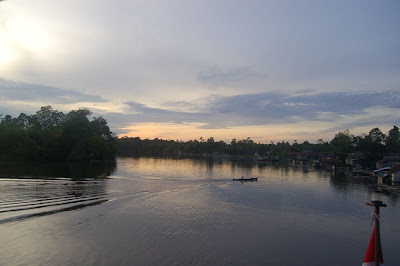
Early next morning, the boat was situated north-south so the sun rise photo with the sun reflected in the water was not a possibility. However, I was there to capture the first boat disturbing the still of the river.
We spent the day on the river and this turned out to be the best day to see the Orangutans up close. Saving the Orangutans is big business in Indonesia as witness by the billboard we saw as we walked from our plane to the terminal.
I found an interesting article on the Internet about the efforts to save the Orangutans in Borneo.
The Orangutan is the most introverted and antisocial of the great apes. They are solitary animals, spending most of their lives on their own. Even if a group assembles in a well-stocked fruit tree, they take very little notice of each other. Only the young enjoy playing with each other and indulging in mock fights. The males seek females only when they want to mate and play no part in the upbringing of the young or in family life.

They build nests, the only primate to do so, in high trees. The cutting of high trees taking place in most of Borneo is one of the greatest threats to the orangutans.

They are highly intelligent, resourceful animals, capable of amazing feats of memory and learning. In the wild, they can remember the exact location and fruiting seasons of a whole range of trees.

Orangutans have 96% of the same DNA as humans so they are a distant cousin to humans. Chimpanzees have 98%, so they are our closest relatives.
This orangutan has a small watermelon in his hand.
This one is sitting on a platform that the rangers use to deposit fruit. He had a large piece of cloth the size of a shirt which he then placed over his head as if to provide himself with some privacy. He anchored here for 15 minutes, and when he didn’t move, we moved on.
We visited another Dayak village where we anticipated being treated to some young girls dancing. When we docked, the dance troupe was not ready for us to we toured the village until they were. It was very hot and walked very slowly.
And I have added another item to my list of things that are changing the world, satellite dishes. There were several to be seen as we walked through a village containing about 30 houses and a school house and playground. The photo shows what are called “long houses”. They house an entire family. They are far enough from the water that they are not built on stilts.
I must say the dancing girls turning out to be a disappointment. They moved in a circle moving their arms and hands while their feet went, step, together, step-spin 180, together over and over again. And that all time the over-amped, distorted, repetitious music was blasting away.
It was a relief to then enjoy some coconut milk that was provided for us.
There was one girl a little older than the dancers who was a real beauty and when I asked to take her picture, she went into a flirtatious pose.
We moved away from the dock and anchored for the night on the river. The early next morning we ate breakfast as usual. The ex-pats always seemed to have a great liking for toast and on of them in particular usually had 3-4 slices. It reminded me that every breakfast table in the U.K. has a toast holder on the table. The meals on board were always excellent and we were reminded how good fresh eggs tasted. We traveled for 15 minutes at the previous dock at Tangkiling and again forded the plank to a van that drove us back to Pelangkaraya.

The van stopped at a small market area where the 8 of us found some real bargains. I bought a Borneo t-shirt for $2. Judith found an ornate used (which was desired) baby carrier that the mother straps on her back to carry her small baby. In Jakarta, it would have cost 4 times the amount.

The ex-pats were driven to the airport and we were driven to a new hotel, the Rungan Sari, 45 minutes away and enjoyed some food sitting around a swimming pool. The next morning we flew to Jakarta, then to Bali where we spend 4 nights at our favorite hotel, the Laguna in Nusa Dua.

Sunday, March 22, 2009

Day Three on the River in Kalimantan

The danger of writing about an adventure while you are experiencing it is that things that seem important initially don’t quite hold up after the adventure is over. As an example, the photos of the Orangutans previously cited, afterwards are only slightly better than average. But the Orangutan photos that follow are superior and would have been used instead of the previous ones. Does this make sense?

I will cite another example. When we went into the Krueger game reserve in South Africa, the first thing we saw was a couple of zebra. I can still visualize the event. We were thrilled. Soon however, looking at zebra was about exciting as looking at your shoe laces. There were just so many of them and they aren’t all that exotic looking, really.

The boat’s six additional passengers (3 couples) showed up, stowed their belongings, and came on deck. Later, as we started up the river again they were thrilled to see this or that, which seemed to us almost funny. We didn’t think it was anything worth looking at because it was so commonplace. It reminded me of your zebra experience.

I told the zebra story to Amy (whose name I thought was Annie for a while) and how it applied to what was unfolding as our new passengers were pointing out things. She was greatly amused and later commented how funny the story was to her.

I will always remember however, the first time I saw Orangutans in the wild in the trees along the river. Even though later opportunities were even better, the first impression gets imprinted on some part of my brain that allows vivid color to remain.

Our three couples were UK ex-pats living in Jakarta and knew each other from previous trips together. I turned out that this was a different cultural experience for us as we learned about them as they talked around the breakfast, lunch and dinner table with us interacting with them along the way. They were all in their early 50’s or late 40’s, putting them almost in the generation of our children. The men all came equipped with newer models of my Nixon camera and bigger lens also. At times the 3 women would socialize together while the 3 men would be socializing together at the same time. It is common for sexes to separate like this but seeing it reminded me that I prefer being in the company where both sexes are represented.

Seeing this made me examine why this was my preference. When I was in my 20’s and 30’s at parties, I grew bored with man talk after a while (sports, cars, and other toys) and would sidle over to the women to listen. They were just as boring after awhile (children, husbands and other kin). At least I was interested in sports and could hold my own in discussions. If I moved in closer where the women talked, one of the women would thoughtfully include me in their discussion. And having a male included in the group would always move the level of conversation to different level, which I found I enjoyed more. Men’s discussions also change when women are included, for the better I think.

The ex-pats were quite enjoyable and everyone got along well and after two days of having the boat to ourselves, I was a pleasant change to have company. I had little time to write, however, so this post was written a week after returning from Indonesia.

As we were waiting for our new shipmates to arrive, we were docked by a small group of houses where two brothers played in the water along side their house. They had a great time splashing each other and sliding on some of slick vegetation just below the water’s surface. They were fun to watch and their enthusiasm was energizing.


After a while we had to move the boat however. Laying in the water along side our boat were two dead stinking pythons. They had been captured, skinned, and then thrown in the river where their carcasses got caught in some debris on the river’s edge. They were about 12 feet long and about 6 inches in diameter.

Our new companions arrived with little luggage as they were only staying 2 nights on the boat, but brought a cooler of beer, wine, and plenty of snacks with them, which they generously shared with us. Before we started up the river again, they were given a large canoe type motorized boat ride like we had the day before. We declined to go with them as we preferred to watch more orangutans on the opposite shore.
Once underway again, our destination turned out to be a village near the hills seen from the boat.
And this was our dock. We took off our shoes and walked gingerly over a plank laid down for us.
Villages come here to bathe, to wash clothes, to scale fish, to swim, and catch fish. These girls were quite shy about having their picture taken and only when they were not looking in my direction was I able to catch their faces.
We were driven to one of the hills and some of us climbed the bigger hill while some of us were driven to a Catholic monastery.
We climbed up a tended path to the top of the hill. Dispersed along the way were several statues which depicted the various stages of Jesus Christ’s crucifixion as described in the Bible. This I found rather sad to see such a waste of resources and effort, but I have little kind to say about religion, of any persuasion. It was also a hot day and the climb had many steps so we welcomed the van and the air conditioning upon our descent.

We picked up the others and then spent the rest of the evening on the boat and docked there during the night.

Thursday, March 12, 2009

Day Two On the River in Kalimantan

Here is an overview map of Indonesia, showing Borneo’s relationship to the area. Palangkaraya is just above the “I” in Indonesia.

The next day we take one of several tributaries of the river and take note of the color change of the water with each new route. From muddy brown, copper colored, and black with various hues in between. All surrounded with an amazing variety of green from the shores with the sky providing the most change to the landscape.


Towards the middle of the day we encountered a tropical downpour and the crew scurried to put up protective plastic tarps completely surrounding the boat. I felt I was in a cave.

But before that suddenly the boat slows and the crew shows us several Orangutans. They are orphans who were discovered near the gold mines, their mothers having been killed by poachers. After they reach a certain age they will be transported to a larger protective national park where they will live in the wild. At any given time I could see seven out of the nine that live there. Three wardens are within 100 yards to watch over them and provide them with bananas and other foods.


The boat is anchored and we slowly drift a little closer and watch them for most of an hour.


The picture below shows four Orangutans. Can you find them? One is at the very top. There is a platform at the bottom where the bananas are placed. Several monkeys could also be seen but they seemed of small import.


And we got closest to this one in a Bamboo tree. Another is partially hidden but visible.
After the downpour we were treated to a motorized canoe ride similar to those constantly seen moving up and down the rivers. We ventured off the river into a maze of waterways some of them very narrow providing some up close views.

We dock for the night where the canoe came to pick us up. I arose early and captured this sunrise.

Up to now we have had the boat to ourselves. Today, 6 others will join us for the next 2 days.


Wednesday, March 11, 2009

Day One On the River-Kalimantan

I suppose life on the river in any country has many similarities. Houses are built to float or are built on stilts to accommodate the rise and fall of the river’s cyclic levels. Where there are larger villages, various shops are built for boats to stop and shop. Woman bathe their offspring and themselves in the river and laundry their clothes there frequently judging by the amount of items drying on clothes lines.


Our boat (the Rahai’i Pangun which can be roughly translated to mean the Big Enterprise) has five cabins below and of course Judith has chosen the best one and in the front of the boat. With the amount of luggage we have, we are able to pile our stuff on the single bed leaving us room to move about comfortably. The boat’s generator provides electricity for all cabins and the two very small toilets. There are cold water showers in the toilets. At night the generator is turned off for the sake of quietness and toilet flushing is done using a small bucket from the water barrel. Lights and an electric fan are still available through battery power.


Most of the day we enjoy the rain forest and beauty of the river while reading or starting a post for my blog, occasionally looking up to see if there is something of interest to see.

A VERY SHORT HISTORY/GEOGRAPHY LESSON OF BORNEO

Borneo is the third largest island in the world after Greenland and New Guinea and three different countries occupy it. The why of this is related to which colonial powers did the most settling. The Western part was greatly influenced the English Spanish and Portuguese and the South-Western part by the Dutch. Mountains in the Northern part of the island formed natural boundaries and water sheds. The about 60 % of the land mass is Kalimantan, Indonesia with two Malaysian states of Sarawak and Sabah facing the South China Sea. Then there is the small separate country of Brunei, which lies between the two Malaysian states.

The native Kalimantan people are Daytaks and our first destination, after 4 hours up the river and ½ hour to fix an overheated engine, we arrive at the village. We dock here and will spend the night. Notice the partially submerged plank we must negotiate to reach shore.


We disembark and walk in the heat of the day, slowly, to view the site where ancestral bones are kept. Now days, the Daytaks are Christians but there are still those who hang onto the old time religion.

Feb-Mar 2001 the Dayaks participated in a massacre against the immigrant Madurese. About 500 people were killed and by April all the Madurese (about 100,000) had fled Kalimantan. Beheadings were witnessed as the Dayaks reverted to the old ways of violence. Granted the majority Dayaks were provoked by the government taking away their land for logging purposes and relocating the Madurese into their territory. I couldn’t help thinking that this happened not to long ago.

Anyway, we go to a place where ancestral bones are kept. Bodies of the dead are first buried, then 5 years later they are dug up and their bones are cleaned and put into boxes. Just another expression of rising from the dead, I suppose. Their descendants can come there from time to time to bring a token gift to keep their spirits placated. The ancestors are provided with some help to ascend into “heaven”. The object on the left is to help pierce through the clouds. The long pole on the right is to provide a springboard which must be an all time pole vaulting record if successful. The red colored statues are replacements for originals which were stolen for their antique value.


During the ceremony that accompanies the unearthing ritual, slaves were tied to the figure below and put to death so the deceased would have someone to tend to them. Now days, slaves have been replaced by animals that serve the same purpose, with minor adjustments I suppose.

A man there explained all this to us and then asked if we would like him and others to play music for us that night. We accepted. Keep in mind that the sun rises and sets about 6 in the morning and at night on the Equator. So when lighting is limited for reading there isn’t a whole lot to do. So sure enough the man and his merry band came and entertained us.

All the instruments were hand made and he was proud to show us each and every one. (Actually they sounded hand made).
Everyone took several group pictures. The young woman on the right was our English speaking guide. Her name is Amie. She met us at the airport and ate with us. She can speak four languages and her English was excellent.